High-Level Overview of EVerest
EVerest is the open source firmware stack for EV charging stations. By digitally abstracting the complexity of multiple standards and use cases, EVerest runs on any device, from unmanaged AC home chargers to complex multi-EVSE satellite public DC charging stations with battery and solar support. EVerest supports all the standards and protocols needed for standards-compliant, interoperable and secure charging. In other words, EVerest does the hard work of translating standards into working code to ensure that every car works with every charger with every charging app and network.
Key features of EVerest
All in all, you can expect the following:
Modular and extensible architecture
Support for AC and DC charging
- Support for EV charging protocols
OCPP 1.6, OCPP 2.0.1 and OCPP 2.1
ISO 15118-2, -3 and -20
IEC 61851
DIN SPEC 70121
- Ready-to-use hardware drivers for many compatible hardware components
BSPs for charge controllers
Powermeters
Isolation monitors
DC Power supplies
RFID/NFC readers
Payment terminals
Energy management implementations and API
Standardized and stable APIs to allow easy integrations
Bring-up modules for custom hardware testing and integration
Ensured standards compliance
OTA service to keep EV chargers up-to-date
Security best practices following OpenSSF
ISO / IEC 5230 open source license compliance
Secure communication channels through TPM
Yocto support for custom embedded Linux images
EVerest Architecture
EVerest contains a rich set of modules that can be combined to build a full EV charging station software stack. The architecture is modular and based on loosely coupled components that communicate via MQTT.
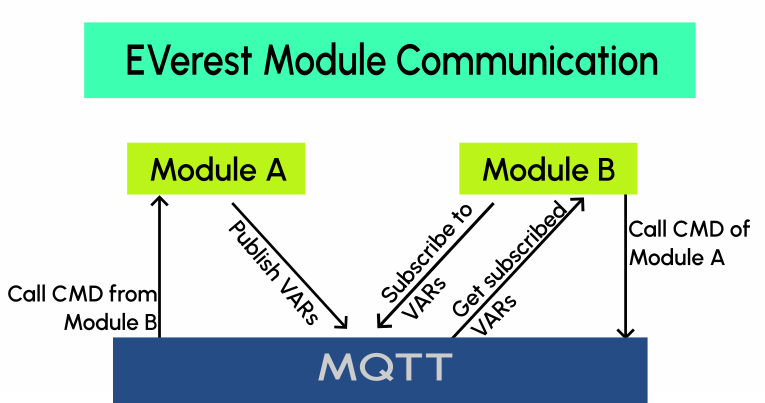
Each module runs as an independent process and communicates with other modules via well-defined interfaces. This allows module to subscribe to variables published by other modules and to call commands provided by other modules.
A more detailed explanation of the EVerest architecture and module concept can be found in the explaination about EVerest modules in detail.
Hardware Requirements
EVerest can run on any Linux-based operating system that comes with the required dependencies. Our (strong) recommendation is Yocto. Find more information on how to set up your Yocto-based environment in the respective EVerest Linux and Yocto guides.
The hardware requirements to run EVerest very much depend on the use case and the modules that are used in the specific scenario. As a general guideline, the following minimum requirements should be met:
CPU: minimum imx6ULL or comparable, recommended is imx93 or AM62x
RAM: minimum of 512 MB, recommended is 1 GB or more
Flash: minimum of 1 GB, recommended is 4 GB or more
Getting Started
Please refer to the Quick Start Guides to get started with EVerest.